

In 2026, brand discovery is no longer limited to “your website vs. competitors’ websites.” Instead, people find companies through short videos, creator collaborations, local map packs, image results, AI summaries, and—more than ever—through social profiles that rank and surface directly on Google. Consequently, when Google expands the way it understands and measures your online presence, it isn’t a minor feature release—it’s a strategic shift.
That’s exactly why the Google Search Console update that introduces social media properties has become one of the most important developments for marketers this year. Traditionally, Search Console was where you validated your website, monitored indexing, tracked performance on Google Search, and fixed technical SEO issues. However, Google is now moving toward a more “platform-aware” approach. In other words, Google is increasingly treating your brand as an entity that exists across multiple platforms—not only on your domain.
This guide from Submitcube explains what it means that Google Search Console adds social media properties, how the feature works, how to set it up, what you can realistically measure, and what actions businesses should take next. Moreover, if you’re operating in a competitive market—such as social media marketing India, where visibility battles happen across Google, Instagram, YouTube, and LinkedIn simultaneously—this update is especially relevant.
Also Read: 55 High-Quality Local Citation Sites in the USA to Improve Local SEO
For years, many brands built SEO strategies primarily around their website, assuming social channels were “top-of-funnel” and separate. But today, social profiles often rank for branded queries, product queries, and even local intent queries. Furthermore, people increasingly treat Instagram, YouTube, and LinkedIn as search engines themselves, then return to Google to validate what they found.
This change in behavior has forced Google to improve how it connects the dots between:
Therefore, when you hear phrases like Google Search Console platform properties, think of a broader visibility dashboard where your “property” isn’t only a domain—it may also be a verified presence on major social networks.
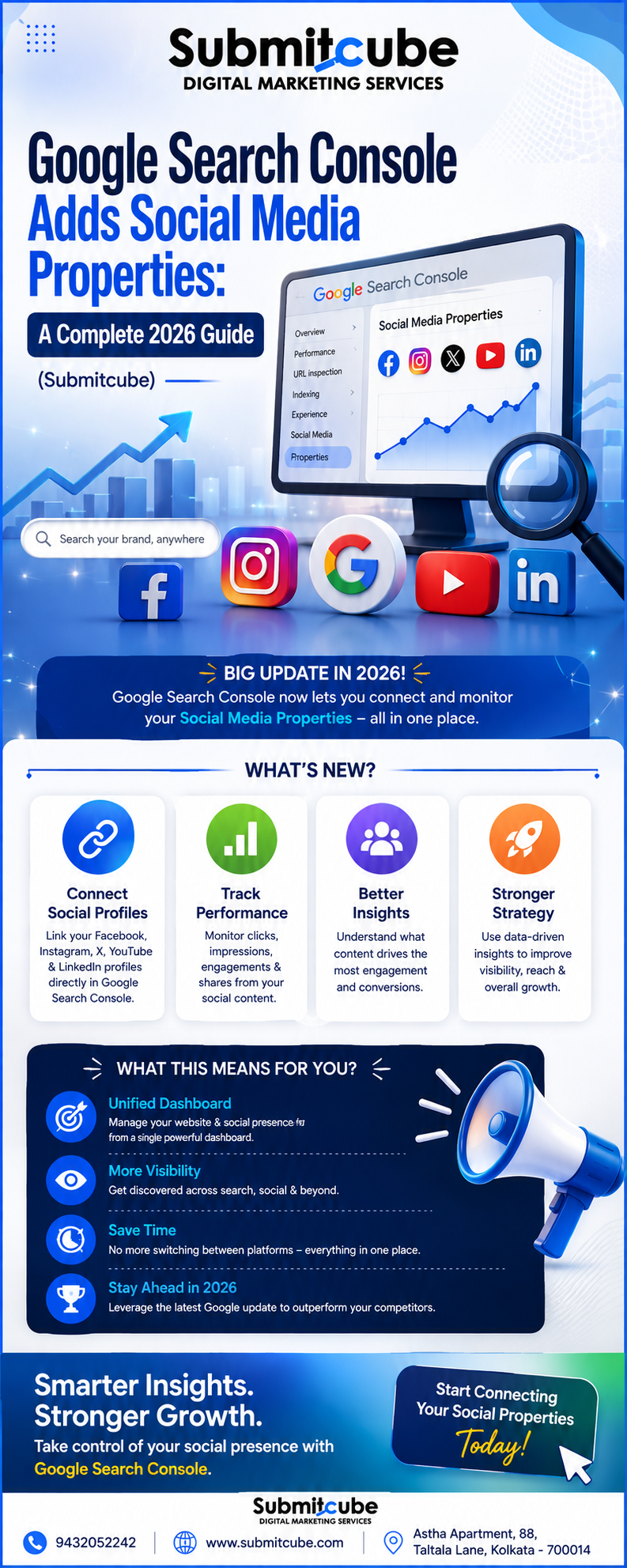
A “social media property” is essentially a verified Search Console property that represents an official social profile/handle or a platform-based presence, similar in concept to adding a domain property or URL-prefix property. Instead of only validating https://www.example.com/, brands can increasingly validate their official profiles to help Google attribute identity and performance to the correct entity.
To be clear, this doesn’t mean your social account suddenly becomes “indexed like a website you control” in the same way. However, it does mean Google is building a more explicit relationship between your brand and its official accounts—something that can influence visibility, trust signals, and reporting clarity.
This is why you’ll see marketers discussing Google Search Console social media capabilities as more than “just another report.” It’s Google acknowledging that brand presence is distributed—and measurable.
Also Read: Updated Australian Business Listing Site List with High DA High PA & High PR Sites
Historically, SEO teams lived in Search Console while social teams lived in native platform analytics (Instagram Insights, YouTube Studio, LinkedIn Analytics, and third-party tools). Meanwhile, leadership teams wanted a single answer to a simple question: What’s actually driving brand demand and conversions?
Now, with social media properties, Google is moving one step closer to unifying brand visibility measurement.
That matters for:
In a competitive region like India, where digital adoption is high and content velocity is massive, social media marketing and SEO can’t operate as separate departments anymore. That’s why this update is being closely watched by every social media marketing company India, from enterprise agencies to boutique specialists—and, yes, by local leaders such as a social media marketing company kolkata that supports brands in fast-moving markets.
Although almost any brand with a legitimate social presence can benefit, the biggest winners tend to be those who rely on:
Moreover, the more “public” your social profile is—and the more it is referenced across the web—the more important it becomes to confirm that Google associates the correct accounts with your brand.
Also Read: Learn The Truth About Usa Directory Submission Sites In The Next 60 Seconds.
A common question is: “Does this mean social signals are now ranking factors?” Not exactly. However, the relationship is more nuanced.
Social profiles can:
Therefore, even if a like or follow doesn’t directly increase rankings, the visibility loop matters:
In short: social media profiles can help “complete the story” of your brand online.
Let’s say you’re a D2C brand or service provider. Someone searches your brand name. Your Instagram profile appears in the results, sometimes above your category pages. If Google can confidently confirm that Instagram profile is official, it reduces confusion, improves brand trust, and can improve how your brand ecosystem is represented.
That’s why so many marketers are searching for step-by-step processes to Add instagram to google search console. Not because Instagram becomes a substitute for a website, but because it becomes a measurable and verifiable part of your search presence.
Also Read: Hire SEO Specialists in India for Long-Term Results
While the exact interface and available metrics can evolve throughout 2026, the intent is clear: Google wants to provide a structured way to associate your brand with your platform identities. Depending on rollout and eligibility, brands may see features such as:
Importantly, you should still use native platform analytics for deep engagement metrics. Yet, Search Console’s value is in explaining what happens on Google Search—and how your social presence participates in that ecosystem.
At Submitcube, we approach this update as a cross-channel alignment project. Instead of treating it as “just another property to verify,” we recommend a structured process that combines SEO hygiene with social credibility.
Here’s the mindset shift:
Therefore, preparation typically includes:
This is where a capable social media marketing company India can add significant value—because the goal isn’t only to post content, but to build a coherent brand footprint that wins on both search and social. Similarly, if you’re a growing business in Eastern India and want fast coordination between SEO and content teams, working with a social media marketing company kolkata that understands local competition can make execution easier.
Also Read: Social Media Marketing vs SEO: Which One Should You Choose?
Although Google’s interface may vary depending on rollout stage, the common flow looks like this:
In practice, you’ll want to ensure:
If you’re investing in social media marketing, this update is your signal to tighten the relationship between your website and your social presence. If you’re managing multiple client brands as a social media marketing agency, this update is a reason to standardize verification and brand consistency across every account. If you’re a founder, it’s your cue to ensure Google and your customers see one coherent brand—not fragmented pages and mismatched handles.
Most importantly, this update rewards brands who treat social profiles as owned assets, not disposable posting channels.
1) What are social media properties in Google Search Console?
Social media properties are verified representations of a brand’s official social profiles within Search Console. Instead of only tracking a website domain or URL, you can also validate certain platform-based identities so Google can better associate them with your brand and potentially report on their presence in Google Search.
2) Why is Google Search Console adding social media properties?
Because user discovery has shifted. People frequently find businesses via social profiles that rank in Google Search, and Google needs a more structured way to connect brand entities to their official platform identities. This helps reduce impersonation, improve brand attribution, and support more accurate reporting across surfaces.
3) Which social media platforms can be added to Google Search Console?
Supported platforms can vary by region and rollout phase. Typically, major platforms are prioritized (for example, Instagram, YouTube, LinkedIn, and others). The best way to confirm is to check the “Add property” options in your Search Console account and look for platform-specific property types under Google Search Console platform properties.
4) How do I add a social media property to Google Search Console?
In general:
If your immediate goal is to Add instagram to google search console, ensure you have admin access to the Instagram account and that your website/social cross-links are consistent.
Also Read: 15 Best Website SEO Audit Tools for Every SEO Professionals and Business Persons
5) Do social media properties help improve SEO rankings?
Not in a simple “verify profile = rank higher” way. However, social properties can strengthen brand clarity, reduce confusion, and support entity understanding. Indirectly, better brand trust and higher branded search demand can support stronger SEO outcomes over time.
6) Can I track social media traffic in Google Search Console?
Search Console primarily reports performance on Google Search (impressions, clicks, queries, and related metrics). It does not replace native social analytics or GA4. However, social media properties can help you understand when social profiles themselves appear and perform in Google Search results, depending on available reporting.
7) Is social media verification required in Google Search Console?
If you want Search Console to recognize a social profile as an official property (where the feature is available), verification is typically required. This helps ensure the person adding the property has legitimate control or authorized access to that profile.
8) Can businesses manage multiple social media profiles?
Yes. Many brands manage multiple profiles by region, product line, or language. Businesses can also manage multiple properties inside Search Console with proper permissions. The key is to keep naming conventions and brand signals consistent so Google doesn’t misattribute profiles.
9) How can social media support my SEO strategy?
Social media can support SEO by:
This is why modern social media marketing services should be integrated with SEO goals, not treated as a separate activity.
10) What should businesses do after this Google Search Console update?
After this Google Search Console update, businesses should:
If you work with a social media marketing consultant or a social media marketing agency, ask them to include “Search presence of social profiles” as part of monthly reporting.
Also Read: Claude AI SEO Strategy: How to Rank Higher on Google
11) Does adding social media properties cost money?
No. Google Search Console is free, and adding properties does not carry a fee. However, you may invest in internal time, agency execution, or tooling to manage reporting and governance.
12) Can social media profiles appear in Google Search results?
Yes. Social profiles frequently appear for branded searches and sometimes for category or local intent queries. This is one reason Google Search Console social media features matter—your profile’s visibility on Google can influence trust and click behavior before a user ever reaches your website.
13) Can social media links help Google understand my brand?
Yes. Consistent linking between your website and your official profiles (and consistent brand identifiers across platforms) can help Google connect the entity dots. While links alone aren’t magic, they contribute to clearer attribution and reduced ambiguity—especially when combined with consistent branding and structured data.
This 2026 shift confirms what top-performing brands already practice: search visibility is now multi-platform. Your website, your social media profiles, your content distribution, and your brand identity all work together.
If you want Submitcube to help you operationalize this change—whether you need an integrated SEO + social media marketing plan, a dedicated social media manager workflow, or end-to-end execution from a social media marketing company India—we recommend starting with a brand footprint audit and then prioritizing the verification and alignment tasks that deliver the fastest credibility gains.
Also Read: How GMB SEO Helped Increase Customer Calls for a Kolkata Business

Subhasish K has working in digital marketing for over Fifteen years. He is a digital marketing consultant, helping digital businesses to open new markets and boost sales. Subhasish is a frequent speaker, and digital marketing expert.